There is a predictable moment in the life of every big idea.
It is the moment when reasonable people gather around a table, look at the numbers, nod thoughtfully — and conclude that it will not work.
The numbers are clean.
The logic is sound.
The consensus is comforting.
And it is almost always wrong.
The Problem With Measuring the Present
In 1979, Akio Morita proposed something strange inside Sony.
A portable music player.
That could not record.
At the time, multifunctionality was the standard. More buttons meant more value. Recording was considered essential.
The research said consumers would reject it.
Morita understood something subtle: people didn’t want more functions. They wanted more freedom.
The Walkman didn’t just sell. It created private soundtracks for public life. It changed culture and redefined that era.
The research had measured what people were used to.
It failed to measure what they were about to become.
A few years later, James Dyson faced a similar dismissal.
Vacuum cleaners were cheap, utilitarian objects. No one formed emotional attachments to them. No one paid a premium.
Dyson built more than 5,000 prototypes to eliminate the bag.
Retailers laughed at the $500 price point.
Consumers, they insisted, would never pay for airflow transparency.
But Dyson wasn’t selling a vacuum.
He was selling relief from irritation — no clogged bags, no performance drop.
Today, Dyson is a design icon.
The price once called absurd became the signal of quality.
Again, the data was correct — about yesterday’s mindset.
The Same Pattern, Repeated in Dubai
Dubai has perfected this rhythm. Emirates Hills, launched by Emaar Properties around 2002.
At launch, the phrase was repeated with conviction:
“Who would build mansions there?”
“It’s too far.”
“It’s the end of the world.”
Infrastructure was still forming. The skyline was distant. The social proof was absent.
Fast forward two decades.
A mansion in Emirates Hills is now being offered at around AED 700 million.
The desert did not change.
Consider Palm Jumeirah.
An artificial island shaped like a palm tree, built into the sea.
The early reaction was predictable:
Too ambitious.
Too risky.
Too engineered.
And yet, it delivered — not just as infrastructure, but as symbolism.
Years later, ultra-prime transactions exceeding $300 million are no longer shocking.
The sea, it turns out, did not read the feasibility study.
Perception did.
Distance, in growing cities, is temporary. Scarcity is permanent.
One of my favorites, and really worth mentioning here, is Le Rêve, Dubai Marina, developed under the visionary Rami Malhas in 2006.
While many towers optimized for density, Le Rêve reduced it.
Fewer units. Larger floor plates. A penthouse philosophy in a market chasing volume.
The objection was immediate:
Too niche.
Too dependent on ultra-wealthy buyers.
Too specialized. And why Dubai? This is not Monaco!!!
And yet, it sold out.
Today, Le Rêve stands as one of the Marina’s enduring luxury statements.
It didn’t follow the template. It ignored it.
The “Too Far” Illusion
Perhaps the clearest example of this recurring psychology is aviation.
When Dubai committed to turning Dubai International Airport into the busiest airport in the world, many doubted the scale.
It happened.
Now, as Al Maktoum International Airport expands with ambitions to become the largest airport globally, the criticism sounds familiar:
“It’s too far.”
“No one will go there.”
“It’s excessive.”
But “too far” in Dubai has historically meant “ahead of the curve.”
Cities expand toward infrastructure, not away from it.
If the first promise was delivered, the pattern suggests the second deserves attention.
The iPhone, Airbnb, Netflix
This pattern is not limited to real estate. One must un-follow this pattern of thinking — the logic that measures what you know, when you don’t know what you don’t know.
When Apple introduced the iPhone in 2007, critics focused on what it lacked — no physical keyboard, no removable battery.
Buttons, they believed, were essential.
Today, glass rectangles define an era.
When Airbnb launched, the idea of sleeping in a stranger’s home seemed absurd.
When Netflix pivoted to streaming, Blockbuster dismissed it.
In each case, the incumbent logic was coherent.
It was also anchored to the past.
The Candle Maker Problem
Imagine gathering ten candle makers and asking how to improve lighting.
They will refine wax. Improve wicks. Extend burn time.
They will not invent electricity.
Not because they lack intelligence.
But because they are optimizing within a system.
Common sense is often just consensus inside a room designed for yesterday.
There is a rhythm to innovation:
First: “It will never work.”
Then: “It might work.”
Finally: “I always knew it would work.”
- Palm Jumeirah.
- Emirates Hills.
- Dubai Hills.
- Le Rêve.
- Al Maktoum Airport.
Each began with doubt.
Each matured into inevitability.
Common sense is comfortable.
Vision is uncomfortable — especially at the beginning.
But history suggests that discomfort, more often than not, is the earliest signal of transformation.
And the next time someone says,
“Who would live there?”
or
“It’s too far,”
it may not be a warning.
It may be an invitation.
About Author
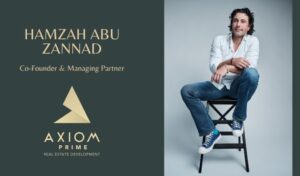
Hamzah Abu Zannad is the Co-Founder and Managing Director of Axiom Prime Real Estate Development. With over two decades of experience in Dubai’s real estate market, he has been involved in delivering projects that prioritize long-term value, thoughtful planning, and sustainable growth.
Through Axiom Prime, Hamzah has focused on developing low-density, community-oriented luxury projects inspired by Dutch living principles. The company’s flagship developments in Jumeirah Village Triangle and Jumeirah Garden City (Satwa) reflect his belief that real estate should create spaces that feel meaningful, functional, and enduring.
With experience, discipline, and a long-term view of the city’s evolution, Hamzah continues to contribute to Dubai’s changing urban landscape.
For more information, visit https://axiomprime.ae
Also Read :-
Human First, Digital Always | Jara Cisneros, Sevilla FC
Jean-Noël Georges: Advancing Digital Trust Through Secure Identity And Biometrics