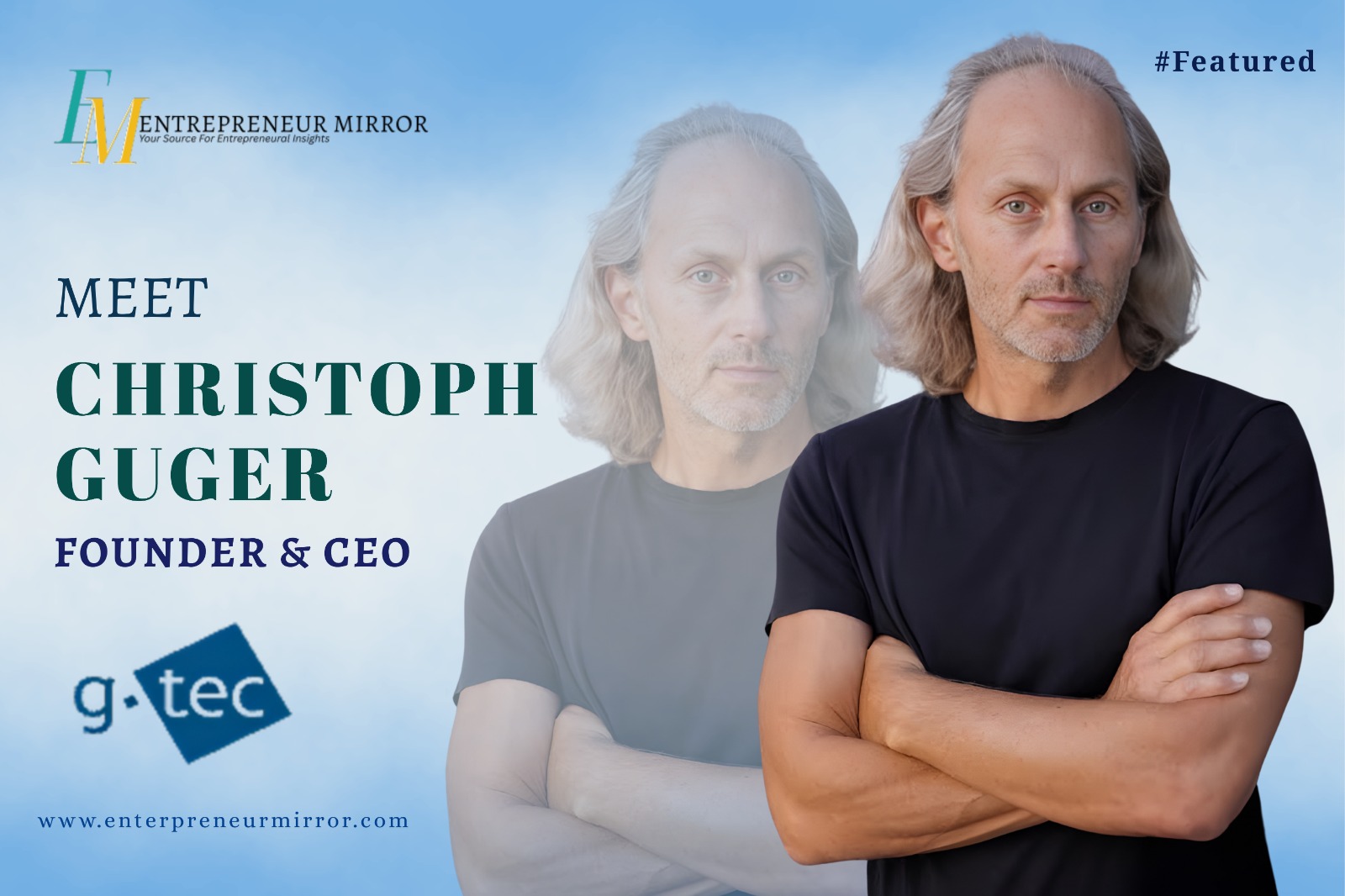
In a world increasingly captivated by artificial intelligence and digital acceleration, Christoph Guger has remained focused on something more fundamental — signal integrity. As the founder and CEO of g.tec medical engineering, he has built one of the world’s leading neurotechnology companies by insisting on a simple but powerful principle: innovation begins with high-quality brain data.
From early academic exploration in Austria to formative research exposure at Johns Hopkins University, Guger’s journey reflects the convergence of engineering discipline and neuroscientific curiosity. What began as a PhD project focused on real-time brainwave processing has evolved into a global enterprise advancing brain-computer interfaces (BCIs), neurorehabilitation, and clinical diagnostics.
In this exclusive conversation, he reflects on his academic foundations, the evolution of g.tec, his philosophy on leadership in neurotechnology, and the advice he offers to the next generation entering this rapidly advancing field.
The Academic Foundations
We began by asking, “Can you share insights into your early life, education, and the experiences that shaped your career path?”
“I grew up with a keen interest in science and technology, which set the foundation for my future endeavors. My academic journey began at the Graz University of Technology in Austria, where I pursued studies that sparked my fascination with neuroscience and technology.
During my graduate studies at Johns Hopkins University in Baltimore, I was introduced to the world of brain-computer interfaces and neurotechnology. When I returned to Graz, I had the privilege of learning from esteemed professors, including Prof. Gert Pfurtscheller, who was developing innovative BCI systems. This experience inspired me to begin my PhD, focusing on creating real-time processing systems to analyze brain waves for cursor control.
After completing my PhD in 1999, I founded g.tec medical engineering to commercialize the technology I had developed. My goal was to make high-quality neurotechnology accessible and contribute to advancements in this field, which I remain passionate about to this day.”
Building a Global Neurotechnology Company
Continuing the discussion, we asked, “Could you tell us about your company and its presence in your region?”
“g.tec medical engineering is a pioneering company in brain-computer interfaces and neurotechnology, with research and development hubs in Austria and Spain. We collaborate closely with universities and hospitals to develop and validate our BCI systems, ensuring scientific rigor and clinical relevance.
Our products serve the international market, with sales offices in the USA, Canada, Colombia, Spain, Hong Kong, Japan, and Australia.
Our flagship medical products include recoveriX for neurorehabilitation, cortiQ for precise functional brain mapping, and mindBEAGLE for assessing patients with disorders of consciousness. We also offer the Unicorn Hybrid Black, an easy-to-use device that provides high-quality EEG data for researchers and educators.
Beyond products, we organize the BCI Award and the br41n.io BCI Hackathon series to foster innovation. We also host the g.tec BCI & Neurotechnology Spring School, one of the largest neurotechnology events globally, attracting over 80,000 attendees annually.”
Leadership in Neurotechnology
Shifting focus to leadership, we asked, “What qualities make a successful leader in your industry?”
“Successful leadership in neurotechnology requires prioritizing high-quality products. A leader must deeply understand every aspect of the system, especially in measuring high-quality EEG data.
It is important not to assume that feeding any signal into deep learning software will automatically produce meaningful applications. True innovation requires meticulous attention to data quality.
Leaders must stay at the forefront of developments, invest in research, collaborate with experts, and foster an environment that encourages exploration. Adaptability, vision, and a commitment to quality define effective leadership in this rapidly evolving field.”
Navigating the Digital Revolution
Turning to innovation and adaptation, we asked, “How has your organization responded to ongoing digital and technological changes?”
“At g.tec, we actively lead advancements in brain-computer interface technology. Numerous master’s and PhD students contribute fresh ideas and research, ensuring we remain at the cutting edge.
We participate in international research projects spanning Japan to the USA. This global collaboration enhances the quality of our developments and allows us to integrate the latest technological advancements into our products.
By fostering continuous learning and collaboration, we are well positioned to navigate the challenges and opportunities of the digital age.”
Advice for Emerging Innovators
As the conversation concluded, we asked, “What advice would you offer to someone just starting out in neurotechnology?”
“My advice is to go full speed in one direction. Focus your energy on a specific area within the field and develop deep expertise.
I also encourage collaboration and leveraging existing technologies and knowledge. This approach saves time and allows you to concentrate on new applications. Build a network of mentors and peers. The neurotechnology landscape evolves rapidly, and passion combined with focused commitment will help you stay ahead.”
Final Reflection
Christoph Guger’s journey demonstrates that in neurotechnology, precision is power. In an industry where digital acceleration often outpaces validation, his work underscores a foundational truth: the future of brain-computer interfaces depends not merely on algorithms, but on the integrity of the signals that drive them.
Through g.tec medical engineering, he continues to shape a global ecosystem where research, clinical relevance, and technological innovation converge — translating brainwaves into measurable impact.
Follow Dr. Christoph Guger on LinkedIn.
Find g.tec medical engineering on LinkedIn and visit their website https://www.gtec.at/shop/
Also Read:-
Wim Ouboter: Why Bigger Is Over — The Future Of Small Mobility