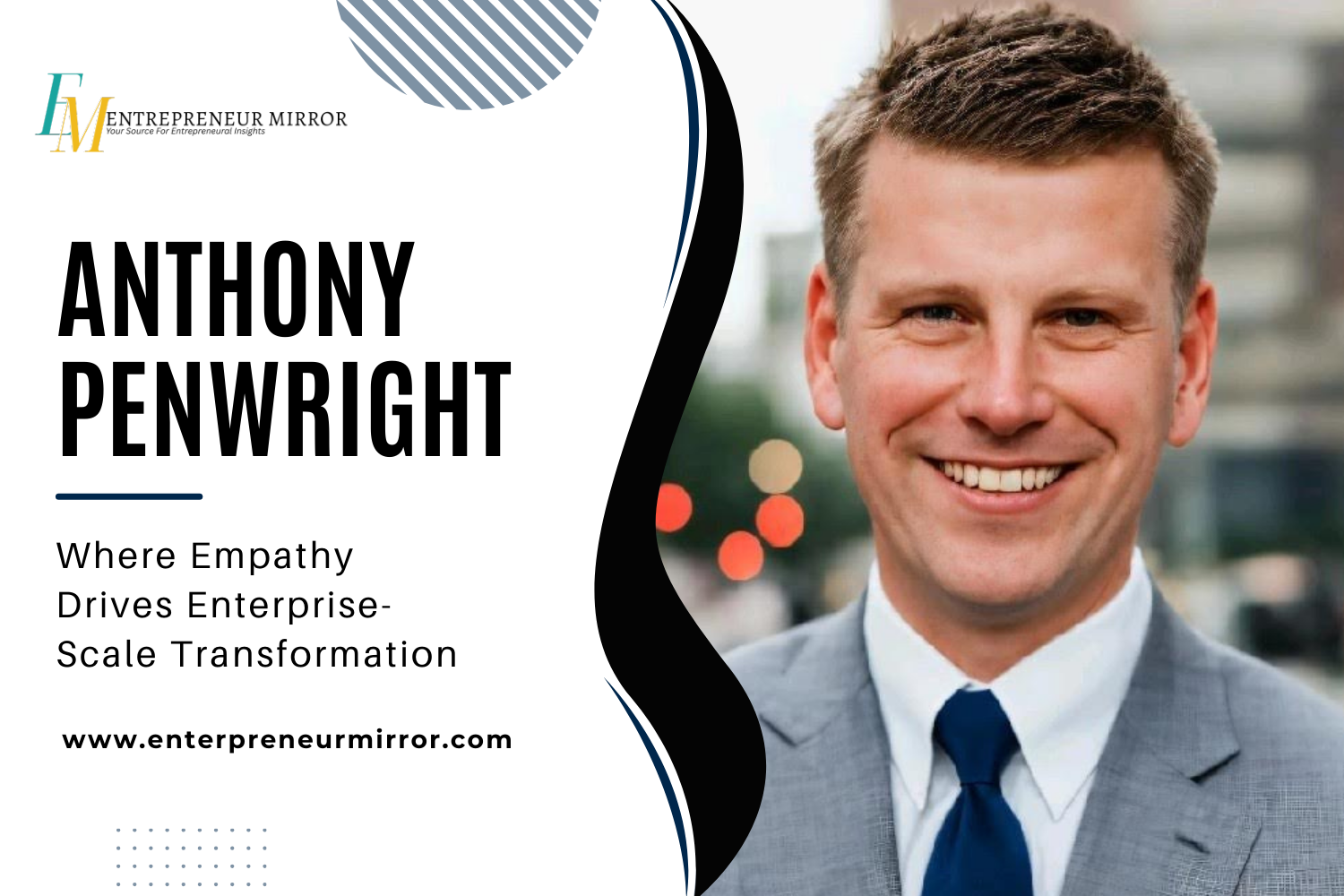
With more than two decades of global experience delivering complex digital transformation programs valued at over £1BN, Anthony Penwright has led at the highest levels across the UK Government, Cisco, Wipro, Wipro, and NEOM. An MBA-qualified technology leader specializing in Smart Cities, IoT, AI, and Blockchain, he has directed cross-functional teams of over 450 professionals while shaping innovation ecosystems at scale.
We recently had the opportunity to interview Anthony Penwright to understand the mindset behind his leadership, his approach to enterprise transformation, and his perspective on the accelerating AI revolution. Throughout our conversation, one theme remained consistent. Technology may enable progress, but people determine its success.
Here is what he shared with Entrepreneur Mirror.
From Uniform to Innovation: “What Sparked the Shift?”
When asked about the origins of his journey, Anthony reflected thoughtfully on the unexpected beginnings of his career.
“I actually began my career in the Police Force. At that time, I was seeking stability after facing some challenges as a late teenager. It felt like a secure and structured path.
However, I quickly realized that while I valued helping people, I was more fascinated by the technology and systems that enabled operations behind the scenes. A senior leader noticed that I had strengths in both people engagement and technology. He told me that technology would shape the future and that I should consider moving in that direction.
I took that advice seriously. I invested the savings I had into professional IT qualifications. That decision shaped everything that followed. Over the last 22 years, combining technical expertise with people skills has allowed me to lead programs from UK Government to global enterprises and now NEOM.”
He acknowledged that sometimes a single piece of advice can redefine an entire trajectory.
The Human Equation of Change: “What Has Been Your Toughest Challenge?”
As our discussion turned toward transformation at scale, Anthony emphasized that complexity rarely lies in code or systems.
“Every major challenge I have faced ultimately comes back to people. If you do not get people alignment right, nothing else works.
Large transformation programs require organizations to change direction. They must adopt new operating models and new ways of working. Naturally, resistance emerges. Humans are not wired for sudden change.
The key is empathetic leadership. You must communicate clearly, create understanding, and build energy around the desired outcome. Emotional intelligence plays a bigger role than pure technical intelligence in these situations.
During transformation programs involving more than 450 professionals in the UK Government, success was built on trust first and execution second. When people feel included and validated, progress accelerates.”
He concluded that ignoring the human element multiplies difficulty unnecessarily.
The AI Inflection Point: “What Trends Will Define the Next Five Years?”
When we asked about the future, Anthony spoke with conviction about Artificial Intelligence.
“AI adoption is accelerating across every sector. That is not a future trend. It is already happening.
The real challenge will not be capability. It will be how organizations manage the human side of AI integration. Many people are genuinely concerned about job displacement. Governance frameworks are still evolving. Ethical considerations are still being defined.
The leaders who succeed will be those who understand both the technology and the change management required to implement it responsibly. That is one reason I am currently completing an MBA in Artificial Intelligence alongside my executive role. Understanding both architecture and psychology will define the next generation of leadership.”
He emphasized that AI success will depend as much on trust as on algorithms.
Reinventing Traditional Industries: “How Will Emerging Technologies Reshape Your Domain?”
Discussing industries such as construction, Anthony highlighted the scale of opportunity ahead.
“Construction, alongside aviation, is one of the more traditional industries in terms of digital maturity. That creates enormous opportunity.
AI and emerging technologies can enable real-time traceability, smarter workflows, and contextual decision-making. Delivering the right knowledge to the right individual at the right time changes outcomes dramatically.
Business models will shift. Workflows will become fully digitized ecosystems rather than fragmented processes. Productivity levels will increase significantly within the next 12 to 24 months. This transformation is already underway.”
He noted that early adopters will gain disproportionate advantage.
Beyond Enterprise:” What Is Your Long-Term Vision?”
When asked about his personal aspirations, Anthony shared his entrepreneurial ambition.
“I genuinely enjoy leading within large organizations and intend to continue doing so effectively. However, I also aspire to build something independently.
I am currently at the pre-seed stage with a validated product ideology. My ambition is to create a culturally strong company where people feel intrinsically motivated. A company is nothing without its people.
The strategy is clear. Secure the right investment. Build the product thoughtfully. Recruit individuals based on personality, emotional intelligence, and cultural alignment. Skills can be taught. Character is foundational.”
He described this vision as his long-term north star.
Principles Over Profit: “What Guides Your Decisions?”
As our conversation deepened, Anthony explained how he balances commercial clarity with human awareness.
“In commercial business, revenue and measurable outcomes are essential. Every initiative must create value, align with strategic goals, and deliver against clear KPIs.
However, execution matters equally. I prioritize empathy, transparency, and structured governance. In complex environments such as government or large-scale smart city initiatives, clear accountability builds credibility.
I also believe leaders must model the behavior they expect. I stay present with my teams and remain approachable. When leaders build a strong foundation of support, teams respond with commitment when it matters most.”
He stressed that credibility is earned through consistency.
Innovation as an Ecosystem: “What Strategy Delivered Breakthrough Results?”
When discussing innovation, Anthony shared a structured framework rather than a single moment.
“Innovation requires an ecosystem. It begins with properly defining business problems rather than jumping to predefined solutions.
Next, build a supply ecosystem that includes accelerators, institutes, venture capital networks, and suppliers. Every promising concept should go through proof-of-concept testing in a controlled environment.
The most overlooked element is commercial structure. Traditional enterprise procurement processes can suffocate startups. Flexible sourcing models and supportive commercial terms are essential if you truly want innovation to flourish.”
He emphasized that innovation must be nurtured intentionally.
Leadership as Reciprocity: “How Has Your Style Evolved?”
As our interview concluded, Anthony reflected on his leadership journey.
“Empathy has always been my foundation. What has evolved is my understanding of different frames of reference. People come from diverse cultures, backgrounds, and capabilities. Understanding that diversity strengthens teams.
Leadership is an energy exchange. When you invest in people, they reciprocate during critical moments. Once that empathetic foundation is built, task-oriented execution becomes far easier.
I continue to invest heavily in self-development, both technically and psychologically. Understanding systems is important. Understanding people is essential.”
He ended our conversation by reaffirming that sustainable transformation begins with trust.”
Anthony Penwright’s journey is a powerful reminder that in a world driven by automation and digital acceleration, empathy remains a competitive advantage. Technology may enable transformation, but leadership rooted in human understanding ultimately determines its success.
Connect with Anthony Penwright on LinkedIn to gain industry insights.
Also Read:-
Milan RAŠKOVIĆ’s Architecture Of Responsibility And Urban Evolution
Tony Wu-Pasomthong | Intelligent Battery Infrastructure Leader