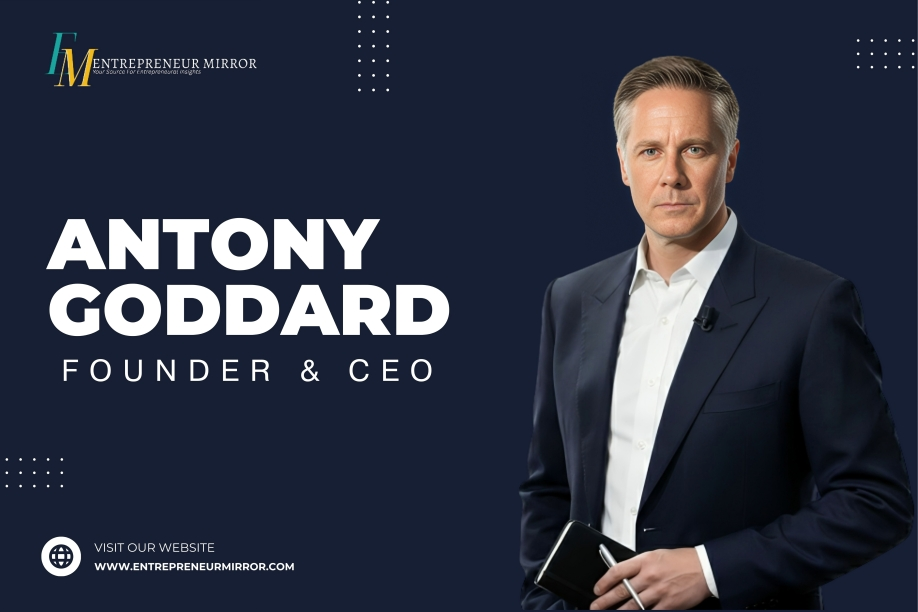
We recently had the opportunity to have an insightful conversation with Antony Goddard, a trailblazing leader, and founder and CEO of several multinational financial service firms. Bringing over 25 years of experience in the financial sector, Antony’s professional path has been defined by an in-depth knowledge of the market, alongside a relentless pursuit of technological advancements. Currently, as the CEO of OKKAMI, he is even revolutionizing the hospitality sector, offering a leading guest engagement and IoT automation platform. Additionally, Antony is an official member of Forbes Councils, fulfilling his vision to build a strong network across multiple industries and to stay ahead of the curve.
Growing OKKAMI into a platform of connected solutions, Antony Goddard plays an instrumental role in establishing the company as one of the leading global technology partners in the current times.
Career Trajectory of Antony Goddard
We started the interview by asking, “Could you share a bit about your early background, education, and the key experiences that shaped your career journey?”
Antony Goddard shared, “My career journey has been shaped less by a single defining moment and more by a sequence of experiences across industries, regions, and leadership roles that collectively built my perspective on technology, scale, and human-centered innovation. I began my professional life in multinational, finance-focused organizations, where structure, discipline, and accountability were non-negotiable. Those early years instilled a strong appreciation for governance, process, and measurable outcomes, principles that continue to guide how I operate today.
While my formal education provided the foundational tools, critical thinking, analytical rigor, and communication, the most meaningful learning happened on the ground. Working across multiple countries exposed me to vastly different business cultures, customer expectations, and operational realities. This global exposure became one of my greatest assets. It taught me how to listen before acting, how to adapt without compromising core values, and how to build systems that scale across borders rather than collapse under complexity.”
He even mentioned, “A pivotal shift in my career came when I moved from purely financial environments into technology-led businesses. Technology, when done right, is a powerful equalizer, it can simplify complexity, unlock efficiency, and create entirely new experiences. However, I also saw firsthand how technology often fails when it is built in isolation from real users. That realization fundamentally shaped my leadership philosophy: technology must always serve people, not the other way around.
Joining OKKAMI marked a defining chapter. Rather than founding the company, I stepped into a leadership role to scale and professionalize the business. This required a different mindset, one focused on stewardship, long-term value creation, and operational excellence. I had to align vision with execution, bridge the gap between engineering and commercial teams, and ensure that innovation translated into real-world impact for clients.
Ultimately, my journey has been about connecting disciplines, finance, technology, operations, and human behavior. Those intersections are where meaningful innovation happens. Every role I’ve held reinforced one belief: sustainable success is built not on hype, but on clarity of purpose, disciplined execution, and an unwavering commitment to delivering value.”
Evolution of OKKAMI over the Years
We then asked, “How has your company evolved since its inception?”
Antony Goddard explained, “OKKAMI’s evolution has been both deliberate and organic, shaped by market needs rather than trends. When the company first launched, it was focused on a very specific challenge: improving the in-room guest experience in hospitality through connected technology. At the time, many solutions were fragmented – hotels were deploying tablets, apps, and systems that didn’t speak to each other. OKKAMI set out to solve that integration problem.
Since those early days, the company has grown significantly in scope, scale, and ambition. What began as a compact team focused on a single product offering has evolved into a multi-disciplinary organization spanning product development, engineering, customer success, partnerships, and enterprise sales. Our team now supports clients across multiple regions, with deployments in luxury resorts, international hotel groups, mixed-use developments, and increasingly, non-hospitality smart properties.
Market reach has been one of the most visible indicators of our evolution. Initially concentrated in Asia-Pacific, OKKAMI has expanded to serve global brands with properties across Europe, the Middle East, and the Americas. This expansion required more than sales growth, it demanded enterprise-grade infrastructure, scalable APIs, security-first architecture, and the ability to support complex operational environments.”
Antony Goddard added, “From a revenue perspective, growth has been steady and resilient rather than explosive for its own sake. We prioritized sustainable recurring revenue models over short-term wins, focusing on long-term contracts and deep client partnerships. This approach proved especially valuable during periods of industry disruption, where many competitors struggled while we continued to expand existing relationships.
Perhaps the most important evolution, however, has been strategic. OKKAMI is no longer positioned solely as a hospitality technology provider. We are intentionally expanding into the broader PropTech ecosystem, supporting smart buildings, branded residences, and connected living environments. This shift reflects our belief that the future lies in unified digital experiences across the entire property lifecycle.
OKKAMI has grown from a product into a platform, from a hospitality tool into a connected property solution, and from a regional player into a global technology partner.”
Impact on the Regional Business Ecosystem
To learn more about the impact of Antony Goddard’s business on the region, we asked, “How does your business contribute to the ecosystem in your region?”
Antony Goddard explained, “OKKAMI’s contribution to the regional ecosystem goes far beyond software deployment. At its core, we act as an enabler—helping properties, operators, and technology partners modernize their operations while creating better experiences for end users. In regions where digital transformation is often uneven, our role has been to bridge the gap between legacy systems and future-ready infrastructure.
One of our most meaningful contributions is helping traditional industries adopt technology without disruption. Many hotels and properties operate on decades-old systems that are deeply embedded in daily operations. Replacing them outright is risky and costly. Instead, OKKAMI integrates with existing ecosystems, allowing operators to innovate incrementally while protecting prior investments. This approach reduces resistance to change and accelerates adoption.
We also contribute by strengthening the local technology and talent ecosystem. Our teams collaborate closely with regional engineers, designers, and implementation partners, creating opportunities for skill development and knowledge transfer. By working on enterprise-grade, global deployments, local talent gains exposure to international standards and best practices, which benefits the wider tech community.”
“From a business ecosystem perspective, OKKAMI acts as a connector. We integrate with PMS providers, IoT manufacturers, payment platforms, and analytics tools, enabling interoperability rather than vendor lock-in. This openness encourages competition, innovation, and collaboration—key ingredients for a healthy technology ecosystem.
Additionally, we support sustainability and operational efficiency, which are increasingly critical in our region. By digitizing services such as in-room dining, guest communication, and service requests, properties reduce waste, optimize staffing, and lower operational costs. These efficiencies have both economic and environmental benefits, aligning with broader regional sustainability goals.
Ultimately, our contribution lies in helping the region leapfrog stages of digital maturity. Rather than replicating outdated models from elsewhere, we enable properties to adopt modern, flexible, and scalable solutions that position them competitively on a global stage,” Antony added.
What Defines Success in the Tech Landscape
To understand Antony Goddard’s views on three qualities which he believes are critical for success in his industry, we asked him to share them.
Antony Goddard commented, “The technology and PropTech industries are fast-moving, competitive, and often unforgiving. While skills and experience matter, I believe three qualities consistently separate those who build lasting businesses from those who chase short-term success. The first is clarity of purpose. In an industry driven by innovation, it’s easy to be distracted by trends, buzzwords, and investor narratives. Successful leaders and companies have a clear understanding of the problem they are solving and for whom. At OKKAMI, every product decision is anchored in a simple question: Does this create tangible value for the operator and the end user? Without that clarity, technology becomes noise.
The second quality is resilience. Building in this space means navigating long sales cycles, complex integrations, and constant technological change. There are setbacks—projects that take longer than expected, partnerships that don’t materialize, markets that shift overnight. Resilience is not just persistence; it’s the ability to adapt without losing momentum or morale. Organizations that endure are those that learn quickly and keep moving forward.
The third is collaborative leadership. No modern technology solution is built in isolation. Success depends on cross-functional teams, external partners, and client collaboration. Leaders must be able to translate between technical and commercial worlds, align diverse stakeholders, and create environments where teams feel ownership rather than instruction. Collaboration accelerates innovation and reduces friction.
Together, these qualities create a foundation for sustainable growth. Skills can be hired, products can be rebuilt, and strategies can evolve—but without purpose, resilience, and collaboration, long-term success remains elusive.”
Embracing Innovation and Latest Trends
Innovative practices are paramount for business success. So, we asked Antony Goddard, “How has your organization adapted to technological changes? Share a key innovation you’ve implemented.”
Antony Goddard mentioned, “Adaptability has been central to OKKAMI’s strategy from the beginning. The pace of technological change—particularly in cloud computing, mobile platforms, IoT, and AI—means that static solutions quickly become obsolete. Rather than reacting to change, we’ve focused on building a flexible architecture that evolves alongside it.
One of the most important shifts we made was moving from feature-driven development to platform-driven innovation. Early on, many hospitality solutions were built as standalone tools. We recognized that the future required interoperability. As a result, we invested heavily in API-first architecture, enabling seamless integration with PMS systems, payment gateways, CRM platforms, and IoT devices. This decision positioned us to scale rapidly without rebuilding our core.
A key innovation has been our unified guest and resident engagement layer. Instead of treating mobile apps, in-room tablets, web portals, and messaging as separate channels, we consolidated them into a single experience layer. This allows operators to manage content, services, and communication centrally while delivering personalized experiences across devices. The operational efficiency gains for clients have been substantial.”
Antony even mentioned, “We’ve also embraced data and analytics as strategic assets. By capturing interaction data across touchpoints, we help properties understand guest behavior, service bottlenecks, and revenue opportunities. This shift from reactive service to predictive operations is becoming a major differentiator.
More recently, we’ve begun embedding AI-driven capabilities to automate responses, personalize recommendations, and support staff workflows. Importantly, we approach AI pragmatically—not as a replacement for human service, but as an augmentation that frees teams to focus on higher-value interactions. Adaptation, for us, is not about adopting every new technology—it’s about choosing the right ones that align with long-term value creation.”
Message to Young Professionals
Addressing the beginners in his field, we asked Antony Goddard, “How would you guide someone to navigate the key challenges you faced when establishing yourself in this industry?”
Antony Goddard responded, “The first piece of advice I give anyone entering this industry is to be patient but intentional. Technology, especially in enterprise environments like hospitality and property management, does not move at startup speed. Sales cycles are long, stakeholders are many, and trust is earned over time. Expecting rapid validation often leads to frustration. Instead, focus on building credibility one relationship at a time.
Secondly, understand the operational reality of your customers. Many challenges I faced early on stemmed from underestimating the complexity of real-world environments. Spend time on-site. Observe how staff work, where bottlenecks occur, and what actually matters day-to-day. Solutions built from boardrooms rarely survive first contact with operations.”
“Thirdly, invest early in partnerships. No company succeeds alone in this space. Strategic alliances with system providers, integrators, and regional partners accelerate market entry and reduce risk. Choose partners who share values, not just distribution channels.
Finally, maintain financial discipline. It’s tempting to scale aggressively, but sustainable growth requires controlled burn rates and clear unit economics. The companies that survive downturns are those that respect cash flow and focus on recurring value. Above all, remember that this is a long game. Industries built around physical assets, human service, and trust reward consistency over hype. If you stay focused on delivering real value, the market eventually responds,” Antony shared.
Connect with Antony Goddard on LinkedIn to gain industry insights.
Find OKKAMI on LinkedIn and visit their website https://okkami.com to learn more.
Also Read :-
Michel Wichman: A Visionary in the Hospitality and Real Estate Sectors
Toni Moral: Reshaping Perspectives around Bitcoin in a Fun Way with Supermultiverse