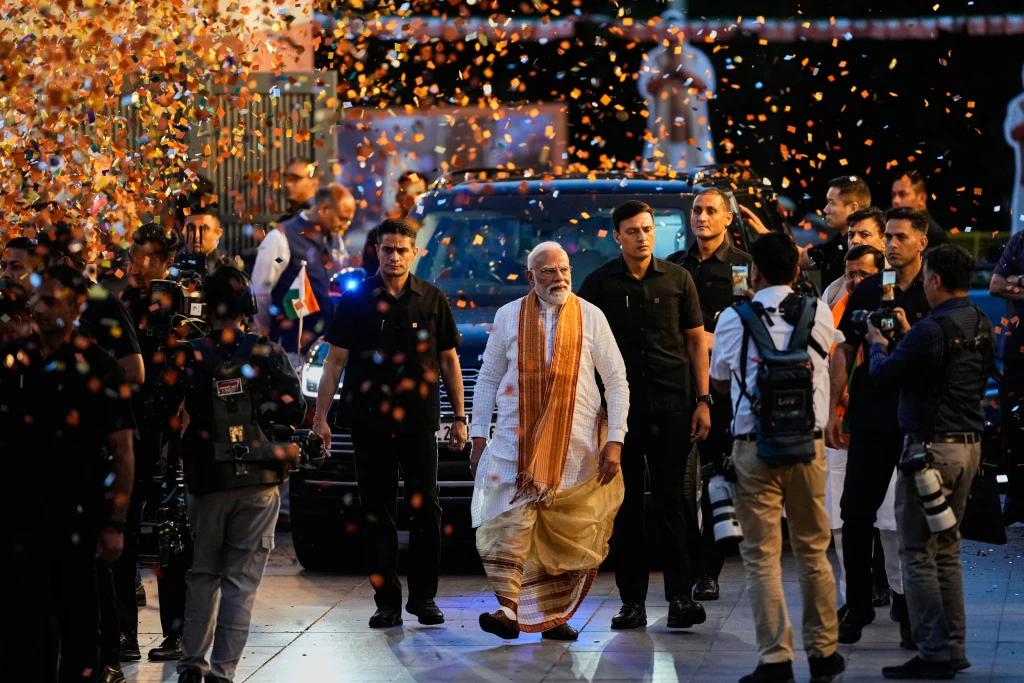
The West Bengal state of India was the notable exception to Narendra Modi’s political progress for many years. His Bharatiya Janata Party (BJP) defeated once-powerful regional rivals, surged over India’s Hindi-speaking heartland, and spread into the west and northeast. Bengal, however, continued to be obstinately resistant while being contentious and deeply rooted in a sense of cultural superiority. Because of this, the state election was very important. With a population of over 100 million, West Bengal has a larger electorate than Germany, making its election more akin to a national election for a government than a typical state election in India.
The BJP’s victory there on Monday would be one of the biggest achievements of Modi’s twelve-year rule. It is the culmination of the party’s protracted advance into eastern India, not just the removal of a three-term incumbent.Author and writer Nilanjan Mukhopadhyay claims that the BJP’s victory in Bengal is significant because it is a land of potential that has long eluded its grasp. There was also a remarkable political upheaval in southern India on Monday.
Actor-turned-politician Vijay and his nascent TVK party overthrew MK Stalin’s DMK government in Tamil Nadu, signaling the dramatic return of movie star politics to the state. The last Communist-led state government in India was overthrown when the Congress-led United Democratic Front (UDF) defeated the Left Democratic Front (LDF) in Kerala after two terms in a row. The BJP and its allies managed to hold onto the federal territory of Puducherry, but they only managed to defy the wider anti-incumbent tide in Assam.
Also Read:
In a Historic Deal with South Korea, the UAE and Qatar Seek a New Gulf-Asia Economic Corridor