
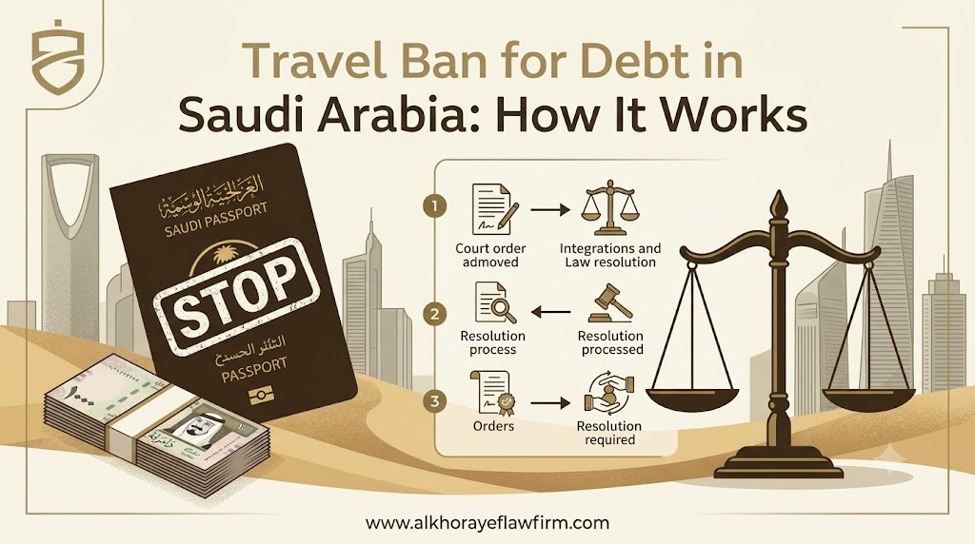

A travel ban is the single most effective debt enforcement tool in the Kingdom, and the most feared. It is enforced at every exit point — airports, land borders, and seaports — so a person subject to one simply cannot leave until the matter is resolved.
This guide explains how a debt-related travel ban actually works, how to check whether one exists against you, how to get it lifted, and — if you are the creditor — how it becomes available to you.
We have written it for both sides, because both sides usually misunderstand the same three things.
Misunderstanding 1: The Bank Did Not Ban You. The Court Did.
This trips up almost everyone.
For a civil financial travel ban, the issuing authority is always the court. The bank or creditor is the petitioner — the party that asked. The court issues the order, and it is registered through the Ministry of Interior system.
Why this matters practically: if you call the bank demanding they “remove the ban,” you are calling the wrong party. The bank can confirm the debt is settled, but only the court can lift the order. Knowing the sequence saves weeks.
The typical sequence runs:
- The creditor files an enforcement case at the Execution Court.
- The court issues its decision.
- The creditor petitions for a travel ban as an enforcement measure.
- The court registers the ban through the Ministry of Interior system.
Misunderstanding 2: It Does Not Expire
An immigration or administrative restriction — an unpaid fine, a visa violation — clears once the underlying fee is settled.
A civil court financial travel ban has no automatic expiry date. It remains active until the underlying debt is fully paid or resolved through a court-approved arrangement. Waiting does not help. Time does not run it out.
This is precisely why it works as an enforcement tool, and why our enforcement services treat it as one of the most reliable routes to actual payment.
Misunderstanding 3: You May Not Be Told
Many people discover a ban at the airport, not before it.
Discovering it at the border is materially worse than discovering it at home. A person stopped at departure may be held while the creditor is notified and the enforcement process takes over. Resolving from that position is harder, more expensive, and considerably more stressful than resolving it in advance.
If you have any unresolved debt in the Kingdom, check before you book.
How to Check Your Travel Ban Status
There are two official channels, and you should use both, because they show different things.
Absher — the broad check.
- Log in at absher.sa with your National ID or Iqama number.
- Go to My Services → Queries → Generalization Report Query.
- Submit.
The report shows whether a restriction exists. Where a ban is present, the reason is generally shown. Note what Absher will tell you: it shows a court restriction, not a “bank restriction” — again, because the court is the issuer.
Najiz — the specific check.
Absher tells you a ban exists. Najiz (najiz.sa) tells you which case caused it. The case record shows the case number, the plaintiff — that is your creditor — and the claim amount.
You need this detail before you can do anything, because you cannot negotiate with a creditor you have not identified.
For workers whose restriction may arise from an employment matter rather than a debt, labour-related status and Huroob reports are checked through the Ministry of Human Resources and Social Development channels, the Absher portal, or the Muqeem platform.
How to Get a Debt Travel Ban Lifted
A ban is generally lifted where the underlying obligation is resolved. Recognised routes include:
Pay the debt. The obvious route, with one very useful wrinkle covered below.
Deposit the sum with the court. Where the debtor deposits the amount with the court as a deposit, the prohibition decision may be lifted.
Settle with the creditor. Negotiate a settlement, payment plan, or restructuring directly with the identified creditor, then apply to the court for lifting on the creditor’s confirmation that the debt is resolved or secured.
Court-approved instalments or a bank guarantee. Where full payment is genuinely not possible, these arrangements can unlock the position.
Withdrawal of the original claim. If a decision is issued to withdraw the original lawsuit, the ban falls away with it.
Then apply formally. The Ministry of Justice provides an online service allowing an enforcement debtor to apply for the lifting of a travel ban restriction, accessible through the Najiz portal. This is the formal pathway once the underlying matter is resolved.
The Frozen Account Trap — And the Way Out
Here is the situation that traps people, and the solution most do not know exists.
The Execution Court often freezes the debtor’s bank accounts and imposes the travel ban together. The debtor then reasons: I cannot pay the debt, because the account I would pay from is frozen. Deadlock.
It is not a deadlock. The Ministry of Justice provides a SADAD invoice service for enforcement debtors through the Najiz portal. It generates a SADAD payment reference, letting the debt be paid through any Saudi bank’s platform, ATM, or payment terminal — without needing access to the frozen account.
Two further points that matter for people outside the Kingdom:
- The service is accessible using a National ID or Iqama number, and does not require Absher access or a Saudi mobile number.
- For former residents who have lost Absher access — often because a deactivated SIM means the OTP no longer works — a Saudi lawyer holding a power of attorney can generate the SADAD invoice through Najiz on the debtor’s behalf. See our guide on how to issue a power of attorney.
Do Not Book Flights Until You Have Verified Removal
Lifting is not always instant across every system. After the debt is resolved:
- Take the settlement documents to the court that issued the ban and obtain clearance.
- Allow processing time for the removal to reflect across systems.
- Re-check Absher and Najiz before booking.
Keep the documentation. Where a ban existed and was lifted, the Najiz record will show the resolved status — and a printed record is often required later by foreign visa authorities who encountered the earlier restriction in their own systems.
Exceptions
There are narrow exceptions. Where a person subject to a ban becomes seriously ill and must travel outside the Kingdom for treatment, travel may be permitted on the issuance of a report from the Ministry of Health.
If You Are the Creditor
Everything above is the reason a travel ban is worth pursuing.
Unlike a judgment that sits unenforced, a travel ban directly affects the debtor’s daily life and has no expiry. It is frequently what converts a paper right into payment. Combined with account freezing and asset seizure, it is the core of practical recovery in the Kingdom.
We pursue these measures for businesses, banks, and financial institutions as part of our debt collection services in Saudi Arabia, covering local and cross-border recovery through our TCM Group partnership across 120+ countries. For company-to-company claims see our B2B debt collection service. If your debtor gave you a cheque that bounced, you are in an even stronger position — see our guide to a bounced cheque in Saudi Arabia.
Whichever Side You Are On
If you are a debtor, act before you are stopped at a border. If you are a creditor, understand that this measure exists and is available to you.
Either way, identify the case on Najiz first — everything else follows from knowing the case number and the parties. You can view our full range of legal services in Saudi Arabia, or if you are still comparing firms, read our guide to the top 10 law firms in Saudi Arabia.
Frequently Asked Questions
1. Who Issues A Travel Ban For Debt In Saudi Arabia?
The court issues it. For civil financial travel bans the creditor or bank is only the petitioner — the party that applies — while the Execution Court makes the order, which is then registered through the Ministry of Interior system. This is why a bank cannot lift a ban on its own.
2. Does A Debt Travel Ban In Saudi Arabia Expire?
No. A civil court financial travel ban has no automatic expiry date and remains active until the underlying debt is fully paid or resolved through a court-approved arrangement. This differs from an administrative immigration restriction, which clears once the outstanding fee or violation is settled.
3. How Do I Check If I Have A Travel Ban In Saudi Arabia?
Use both official channels. On Absher, log in with your National ID or Iqama and run My Services → Queries → Generalization Report Query for the broad check. Then use the Najiz portal to identify the specific case, which shows the case number, the plaintiff, and the claim amount.
4. How Do I Lift A Travel Ban For Debt?
Resolve the underlying obligation — by paying, depositing the sum with the court, agreeing a settlement or court-approved instalment plan, or providing a bank guarantee — then apply through the Ministry of Justice enforcement debtor service on the Najiz portal for the ban to be lifted. A ban also falls away if the original claim is withdrawn.
5. Can I Pay The Debt If My Bank Account Is Frozen?
Yes. The Ministry of Justice provides a SADAD invoice service for enforcement debtors through the Najiz portal, generating a payment reference that can be settled at any Saudi bank platform, ATM, or payment terminal without using the frozen account. It is accessible with a National ID or Iqama number.
6. Can Someone Outside Saudi Arabia Resolve A Travel Ban?
Yes. The Najiz portal can be accessed with a National ID or Iqama number, and where a former resident has lost Absher access because a deactivated SIM no longer receives the OTP, a Saudi lawyer holding a power of attorney can act on their behalf, including generating the SADAD invoice.
7. What Happens If I Try To Travel With An Active Ban?
Travel bans are enforced at airports, land borders, and seaports. A person stopped at departure may be held while the creditor is notified and enforcement proceeds. Resolving the matter from that position is significantly harder and more costly than checking and resolving it in advance.
8. Is There Any Exception To A Travel Ban?
There are narrow exceptions. Where a person subject to a ban becomes seriously ill and needs treatment outside the Kingdom, travel may be permitted on the issuance of a report from the Ministry of Health.
Also Read:-
As The Iran War Intensifies, Ukraine Attacks Russian Cargo Headed For Iran
The Third Drone In Three Days Is Shot Down By Romanian Military