Every enterprise today has access to more information than ever before. Reports arrive instantly, dashboards refresh in real time, and executives can monitor nearly every business metric with a few clicks. Yet despite this abundance of information, many important business decisions are still delayed, debated, or driven by experience instead of structured analysis.
Technology has made it easier to collect data. It has not necessarily made organizations better at acting on it.
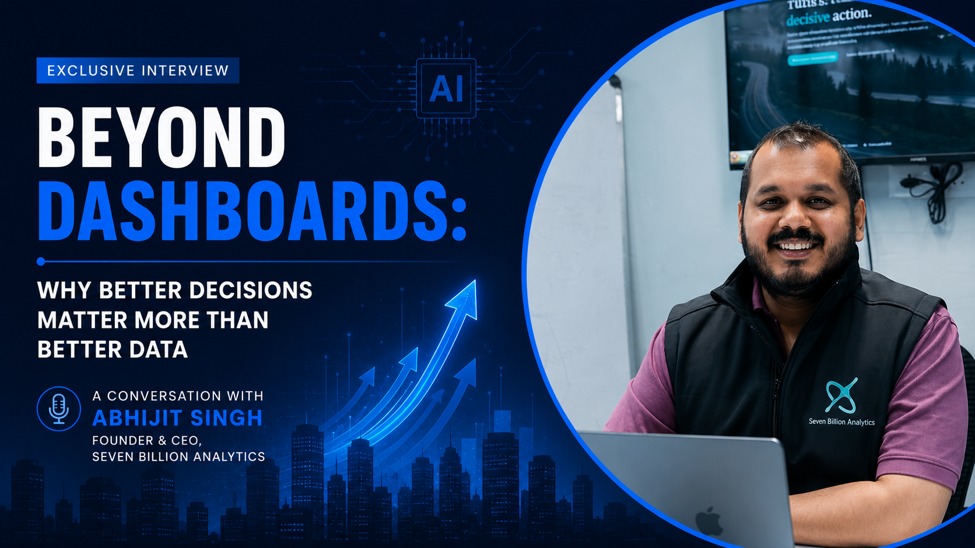
That challenge sits at the center of Abhijit Singh’s work.
As Founder and CEO of Seven Billion Analytics, he works with organizations across manufacturing, FMCG, supply chain, healthcare, and agri-food to help them move beyond reporting toward systems that actively support operational decisions. Rather than treating analytics as the final destination, his focus is on making data useful at the exact moment decisions need to be made.
In this conversation, Abhijit shares why many organizations continue to struggle despite significant investments in analytics, how enterprises should identify meaningful opportunities for automation, why trust is essential before technology can scale, and why the future of enterprise operations depends as much on decision design as it does on intelligent systems.
Key Takeaways
- Business value comes from improving decisions, not simply producing more reports.
- Organizations should identify high-impact business decisions before selecting technology.
- Production deployment requires far more effort than building a successful model.
- Explainability and governance should be designed from the beginning.
- Voice-based enterprise systems can serve operational users who rarely interact with traditional applications.
- The most successful enterprise systems combine automation with appropriate human oversight.
- Organizations should measure success through business outcomes and decision confidence rather than technical metrics alone.
Q1. Organizations have invested heavily in analytics over the last decade. Why do so many still struggle to improve business decisions?
One of the biggest misconceptions is that more data automatically leads to better decisions. In reality, most enterprises already possess enormous amounts of operational data. The challenge is rarely data availability.
The challenge is deciding what to do with that information.
Many organizations have excellent reporting systems and sophisticated dashboards, but when critical operational decisions need to be made—whether it’s production planning, inventory allocation, procurement, or distribution—people often revert to manual judgment because the system doesn’t help them make the actual decision.
That is where the real opportunity exists.
The objective shouldn’t simply be to visualize information better. It should be to reduce uncertainty around important business decisions so leaders can act faster and with greater confidence.
Ultimately, organizations don’t create value from dashboards. They create value from making better decisions consistently.
Expert Insight: Throughout the conversation, Abhijit returns to one consistent idea: analytics becomes valuable only when it improves operational decision-making rather than simply reporting business performance.
Q2. When companies begin exploring enterprise AI, where do you believe they should actually start?
Most organizations start by discussing technology.
They ask which models they should use, which platform they should buy, or which latest innovation they should experiment with.
Those are important conversations, but they usually happen too early.
The better starting point is identifying a business decision that has measurable impact. It should be a decision that happens frequently, carries meaningful business risk when it’s wrong, and currently depends on fragmented or inconsistent information.
Once that decision is clearly defined, technology becomes much easier to evaluate because every technical choice can be measured against a business outcome.
Without that clarity, projects often become technology demonstrations instead of operational improvements.
The goal is never to implement technology for its own sake.
The goal is to improve the quality, consistency, and speed of business decisions.
Expert Insight: Rather than beginning with software or models, Abhijit recommends beginning with a business decision that can produce measurable operational improvement.
Q3. Many AI initiatives perform well during pilots but struggle once they reach production. Why does that happen?
Building a working model is only one part of the journey.
In many cases, it is actually the easiest part.
The much larger challenge begins after that.
Production systems have to integrate with existing business processes, work alongside legacy applications, gain the trust of operational teams, and continue performing reliably under real business conditions.
That requires engineering, governance, change management, and continuous monitoring.
Organizations frequently underestimate this phase because successful demonstrations create the impression that deployment will be straightforward.
In practice, production success depends on much more than model performance.
If people don’t trust the recommendations, or if the system doesn’t integrate naturally into existing workflows, even highly accurate models may never influence business decisions.
That’s why production readiness should be treated as a core objective from the beginning rather than something addressed after a successful pilot.
Q4. You often talk about “decision intelligence.” How is that different from traditional analytics?
Traditional analytics helps organizations understand what has happened or what is happening. It gives leaders visibility into business performance through reports, dashboards, and metrics.
Decision intelligence takes the next step.
Instead of stopping at insights, it focuses on helping people decide what action to take next.
For example, a dashboard may show that inventory levels are increasing. That information is useful, but someone still has to decide whether production should change, whether purchasing should slow down, or whether distribution plans need adjustment.
Our goal is to reduce that gap between information and action.
Technology should support the decision itself, not just display the numbers behind it.
When organizations improve the quality of their decisions, they naturally improve business performance.
Expert Insight: Abhijit’s approach is simple: reports explain the business, while decision intelligence helps improve the business by supporting better operational decisions.
Q5. As more organizations rely on AI, how important are trust and explainability?
They are essential.
No organization should deploy a system that people cannot understand or confidently use.
Business leaders need to know who owns the system, how decisions are reviewed, and what happens when the system produces an unexpected recommendation.
These questions should be answered before deployment, not after.
Explainability is equally important.
When people understand why a recommendation has been made, they are much more likely to trust it and use it during daily operations.
That is especially important for decisions involving production, supply chain planning, procurement, and other operational processes where the cost of a wrong decision can be significant.
Governance should never be treated as an additional feature.
It should be part of the system from the beginning because trust is built through good design.
Expert Insight: Trust is created through ownership, governance, and explainability. These are foundational elements of enterprise systems rather than optional additions.
Q6. Your company has invested in voice technology through VaaniOS. What business challenge does it solve?
Many enterprise solutions are designed for people who regularly use mobile apps or digital platforms.
However, large parts of India’s supply chain operate very differently.
Distributors, retailers, field teams, and many participants across emerging markets often communicate through phone calls in their preferred regional language.
VaaniOS was built for those users.
The platform combines Indian-language speech recognition, neural voice synthesis, and conversational reasoning so users can complete business tasks through natural voice conversations.
One example is supporting distributor order capture.
Another is managing healthcare front-desk interactions.
A deployment that stands out is an agri-distributor in Haryana, where farmers place orders in Haryanvi. The system manages those conversations while allowing human review whenever an interaction requires escalation.
That demonstrates an important principle.
Technology should adapt to how people already work instead of expecting people to completely change their behavior.
Expert Insight: VaaniOS focuses on making enterprise technology accessible through voice for users who may never rely on traditional mobile applications.
Q7. Do you believe enterprises should move toward complete automation?
I believe automation should be practical.
Not every decision should be handled entirely by machines, and not every decision requires constant human involvement.
The most effective approach is finding the right balance.
Routine decisions that follow well-defined business rules can often be handled automatically.
More complex situations, unusual exceptions, or high-impact decisions should be reviewed by people.
That combination allows organizations to improve speed without losing accountability.
For this approach to succeed, organizations first need clearly defined decision processes.
If the decision itself has never been properly structured, there is nothing reliable for automation to execute.
Automation works best when it strengthens good decision-making rather than replacing it.
Expert Insight: Abhijit believes enterprise automation should combine operational efficiency with human judgment, allowing routine work to be automated while exceptional situations continue to receive appropriate human oversight.
Q8. How do you measure whether an enterprise AI project has truly been successful?
Many organizations focus first on technical metrics like model accuracy. Those numbers are important, but they don’t tell the complete story.
The bigger question is whether the system helps people make better business decisions.
If a planning team can make decisions with greater confidence, if operational teams trust the recommendations, and if business outcomes improve, then the project has delivered real value.
One example that stays with me is when the supply chain head of a leading ready-to-eat food company said they could confidently explain and defend their production plan instead of relying on instinct.
That moment represented something much bigger than an accuracy score.
Technology should improve the quality of judgment, not simply generate predictions.
Business success comes when people trust the system enough to use it in their everyday decisions.
Expert Insight: Technical performance matters, but long-term success is measured by stronger business decisions, greater confidence, and meaningful operational outcomes.
Q9. What advice would you give to business leaders who want to begin their AI journey today?
Keep the first step simple.
Don’t begin with a large transformation programme or a long strategy document.
Start by identifying one business decision that happens regularly, has a meaningful business impact, and can be measured clearly.
Solve that problem well.
When teams see measurable improvements from one successful implementation, confidence grows across the organization. Future initiatives become much easier because people have already experienced the value.
Trying to transform everything at once usually creates unnecessary complexity.
Building momentum through one successful business problem creates a much stronger foundation for long-term adoption.
Technology should always support business priorities, not become the priority itself.
Expert Insight: Starting with one measurable business problem creates faster results, stronger internal confidence, and a clearer path for future transformation.
Q10. Looking ahead, what is your long-term vision for Seven Billion Analytics?
Our vision has remained consistent from the beginning.
We want to help organizations become better at making important business decisions.
Whether that involves manufacturing, supply chains, food systems, healthcare, or other operational environments, the objective is the same—to help organizations make decisions faster, with greater confidence, and under uncertainty.
We do not see ourselves as a company that simply builds dashboards or delivers technology projects.
Our focus is helping enterprises strengthen the decision-making process itself.
If the organizations we work with are consistently making better decisions because of the systems we build, then we have achieved what we set out to do.
That is the impact we want to create over the long term.
Expert Insight: Abhijit’s long-term vision is centred on improving how organizations make decisions, ensuring technology becomes a practical tool for better business outcomes rather than an end in itself.
Frequently Asked Questions
Q1. What does Seven Billion Analytics do?
Seven Billion Analytics works with organizations across FMCG, manufacturing, supply chain, healthcare, and agri-food to build systems that help improve business decisions. The focus is on closing the gap between data and operational decision-making rather than simply delivering reports or dashboards.
Q2. Why do many enterprise AI projects struggle after the pilot stage?
Many projects underestimate the work required for production deployment. Successful implementation requires integration with existing systems, operational trust, governance, and reliable day-to-day performance—not just an accurate model.
Q3. What is decision intelligence?
Decision intelligence focuses on helping organizations make better business decisions. Instead of only presenting information, it supports choosing the most appropriate action based on available data.
Q4. Why is explainability important?
Business users need to understand why a recommendation has been made before relying on it for important operational decisions. Explainability builds confidence and supports responsible deployment.
Q5. What is VaaniOS?
VaaniOS is a voice platform designed for supply chain participants who primarily communicate through phone calls in Indian regional languages. It supports business interactions such as distributor order capture and healthcare front-desk operations while allowing human review when needed.
Q6. Should every enterprise decision be fully automated?
No. Routine decisions can often be automated, while complex or exceptional situations should continue to involve human oversight. A balanced approach provides both efficiency and accountability.
Q7. What is the best starting point for organizations exploring AI?
Begin with one clearly defined business decision that occurs frequently, has measurable business impact, and currently depends on unstructured or inconsistent decision-making. Solve that problem first before expanding to larger initiatives.
Also Read:-