
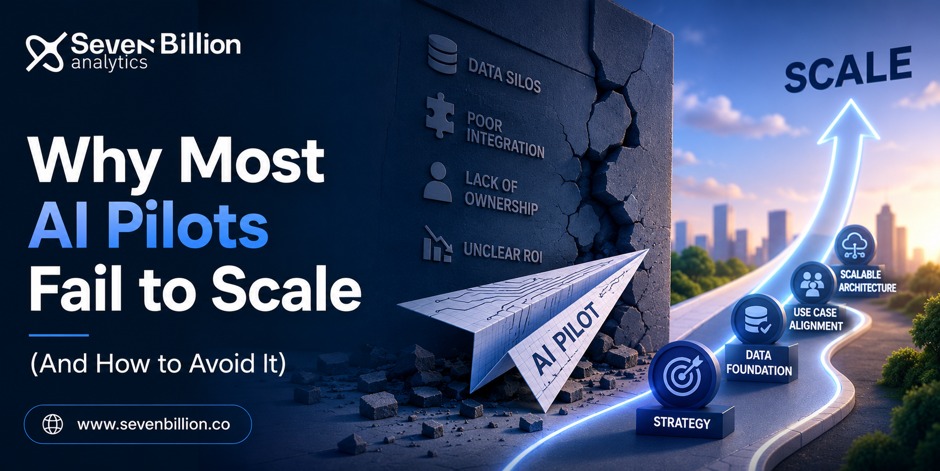
You built an AI demo. It looked promising. The team was excited. Leadership discussions were positive. But months later, the project is still sitting inside presentations and internal meetings without moving toward real deployment.
This situation is extremely common. Industry research consistently shows that nearly 85% of AI projects never progress from pilot stage to full production. In most cases, the technology itself is not the main problem. The bigger issues are usually unclear expectations, poor data quality, lack of ownership, and solutions designed more for demonstrations than real implementation.
So why do some AI initiatives scale successfully while others stop at the pilot stage?
Why AI Pilots Often Fail
Most AI pilots are created to secure approval rather than operate successfully in real business environments. They are often built using clean and carefully prepared datasets that do not reflect the complexity of actual production data. These pilots usually run in isolated environments that are disconnected from the systems the business relies on every day.
Another common issue is the lack of clearly defined success KPIs. It is often easier to generate excitement around a demo than to establish measurable business outcomes from the beginning.
Once the pilot phase ends and deployment work starts, the real challenges become visible. The data is more inconsistent than expected. Existing systems cannot integrate properly. Business stakeholders who supported the initial demo may no longer have time to stay involved in the process. Without agreed KPIs, teams also struggle to determine whether the project is actually succeeding.
This is the production gap, and it is responsible for more failed AI initiatives than technical limitations.
What AI Scaling Actually Requires
Moving AI from pilot stage to production requires elements that many vendors fail to include in their delivery approach.
The first requirement is infrastructure that reflects the real business environment. AI systems must be tested against actual operational conditions rather than controlled demo scenarios.
The second requirement is change management. Teams need to understand how the system works, how it affects workflows, and how it supports day-to-day operations.
The third requirement is a clearly defined success framework. Everyone involved should agree on measurable outcomes before development begins.
Successful AI scaling also requires realistic assumptions about the organization’s current data environment. Even the most advanced pilot will fail in production if it is built on inaccurate or overly optimistic data assumptions.
How Seven Billion Takes a Different Approach
Every engagement at Seven Billion Analytics Pvt. Ltd. begins with Phase 0 — Discovery and Alignment.
Before development starts, the focus is placed on understanding the organization’s data landscape, infrastructure, and business goals. Success KPIs are defined collaboratively, and potential data quality issues are identified early before they become deployment obstacles.
From there, every phase is structured to validate value incrementally using real business data, operational constraints, and actual users from the beginning of the process.
By the time full deployment happens, the organization is not trying to adopt an unfamiliar solution. Instead, the team is scaling a system they have already experienced in real operational environments.
Conclusion
The real question is not whether AI can create value for your business. In most cases, it can.
The more important question is whether the engagement model is designed for real deployment or simply built to create an impressive demo that never reaches production.
If a previous AI pilot failed to scale, it is important to evaluate which of those two approaches was being followed.
Also Read:-