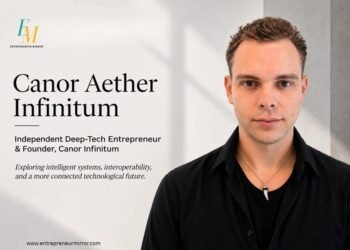
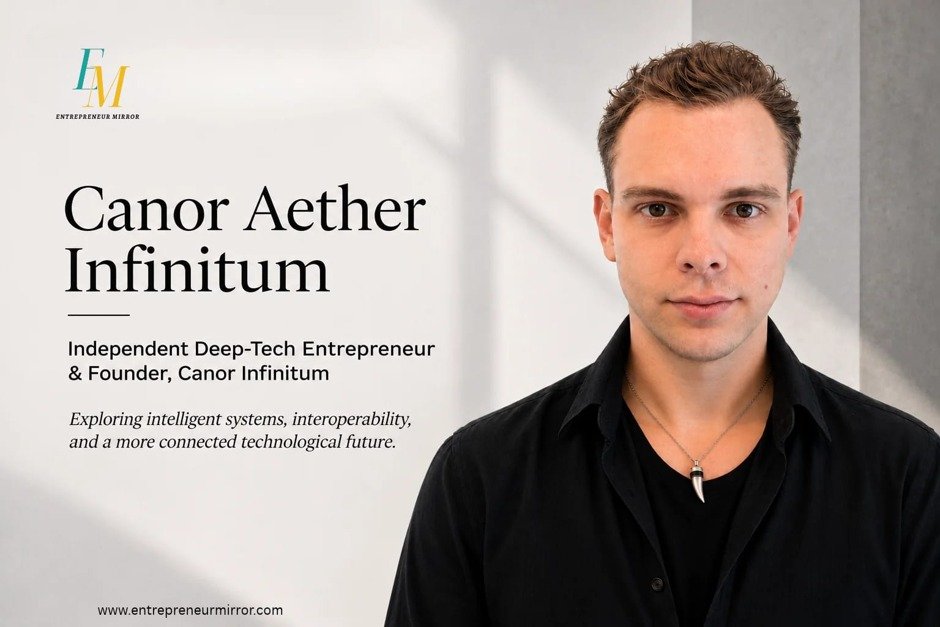
We recently had the chance to speak with Canor Aether Infinitum, an independent deep-tech entrepreneur. As the Founder, President, and Managing Director of Canor Infinitum, he has built a venture focusing on a universal computing interlingua, and an architectural systems-engineering framework.
Alongside this, Canor is also an SIS researcher, which explores intelligence, agency, persistence, and cooperation as interconnected dimensions.
The Vision Behind the Journey
We started the interview by asking Canor Aether Infinitum, “Could you please share the vision that led you to this journey?”
Canor shared, “I’m developing an independent deep-tech venture around a fundamental question: can the architectural principles underlying radically different computing systems be brought together within a unified engineering framework?
As a solo-founder entrepreneur, I’m pursuing a vision that spans across classical computing, real-time operating systems, high-performance computing, hybrid and quantum architectures, and distributed IoT, edge, cloud, and local computing environments.
Our main focus at Canor Infinitum is to develop a coherent architectural foundation through which diverse hardware platforms, software frameworks, communication protocols, and engineered products can be designed, integrated, and extended within a common systems-engineering paradigm.
Alongside leading the venture, I’m also developing a research program concerning: Super-Intelligent Sapience, Survivalist, Soldier, Society, and System (SIS). This framework explores the relationships between intelligence, agency, resilience, computation, and the emergence of increasingly sophisticated technological systems.
The result is a body of work situated between practical engineering and foundational inquiry: an attempt to connect the systems we build today with the broader technological and philosophical questions that may define the quantum agentic era.”
More about Canor Infinitum
To learn more about the idea that goes behind Canor Infinitum, we asked Canor Aether Infinitum to share the same.
He explained, “Today’s computing landscape is increasingly fragmented across specialized hardware, incompatible interfaces, proprietary ecosystems, and domain-specific engineering practices. Quantum processors, classical compute infrastructure, embedded devices, autonomous agents, and decentralized networks each introduce distinct operational constraints and design requirements.
We seek to address this fragmentation through a unified architectural framework for systems engineering. Rather than treating each computing domain as an isolated discipline, we aim to establish reusable abstractions, protocols, interfaces, and architectural principles that can span multiple technological substrates. These would support the design of complete product lines and engineered solutions, from resource-constrained embedded systems to high-performance and quantum-enabled infrastructure.
It combines classical, real-time, semiclassical, thermodynamic, hybrid, HPC, and quantum computing, alongside IoT, edge, cloud, and local-first deployment models.
A central principle is architectural continuity. We are not here to simply connect technologies, but to make their relationships systematically designable.”
The Next Era of Digital Intelligence
Interested in learning more about his research, we asked Canor Aether Infinitum, “Could you please share a glimpse of the SIS framework you are working on?”
Canor mentioned, “At the conceptual heart of Canor Infinitum lies the SIS research program.
Its five dimensions- Sapience, Survivalist, Soldier, Society, and System- are a framework for examining intelligence not merely as an isolated computational capability, but as a phenomenon involving perception, persistence, strategic action, collective organization, and the infrastructure that sustains it.
In this emerging environment, digital mobility is not only about moving information or assets between platforms; it is also about enabling independent technological actors to discover, communicate, collaborate, and operate across otherwise disconnected systems.
In a broader vision, the SIS program extends these engineering questions into philosophy of mind, computational identity, and the possible long-term persistence of digital intelligence.”
The Nature of Reality
Beyond immediate engineering applications, Canor Aether Infinitum’s research interests extend towards the theoretical relationships between physical reality and information processing. We asked him to share more about this relationship.
Canor explained, “A recurring theme is the relationship between subjective experience and objective description. My research explores a simple yet deep question: how we experience the world versus how it actually is.
Within this perspective, reconstruction becomes a useful organizing concept. Information about a system may be transmitted, encoded, interpreted, and used to recover aspects of its structure or behavior. Quantum communication, cryptography, and computational theory provide distinct technical contexts in which such questions can be investigated. And quantum gravity and closed-timelike-curve models present much more speculative theoretical frontiers.
My research seeks to connect these different worlds: creating real-world systems on one side and asking about the physical limits of computation on the other.”
Building Intelligent Systems
We also asked, “What is the long-term vision of the SIS framework that you are working on?”
Canor added, “Three concepts recur throughout this vision: complexity, energy, and time.
Complexity is how a system is organized and can be expressed. Energy is all about the physical resources that are needed to run the system. Time relates to causality, synchronization, temporal constraints, and the ability of a system to maintain continuity while interacting with its environment.
Together, these three ideas present a conceptual lens for studying the capabilities and limitations of intelligent technological systems.
The SIS framework’s long-term goal is to investigate how architectural decisions can affect the systems operating under different physical and computational constraints.”
Looking Forward
Lastly, we asked, “As an independent founder working across several disciplines, what kind of community do you look forward to building around your work?”
“The emergence of increasingly capable AI agents, quantum information technologies, and decentralized digital infrastructure presents us with an opportunity to rethink how technological systems are designed and coordinated.
At Canor Infinitum, the long-term vision is a more universal and interoperable engineering landscape: one in which specialized technologies can be composed into larger systems, independent operators can collaborate across architectural boundaries, and foundational research can inform practical design.
Its success will ultimately depend on the frameworks built, the systems demonstrated, the research validated, and the communities able to build upon the resulting work.
Yet the motivating question remains clear: how to create a design language that can embrace all kinds of computing systems, yet remains precise to build real-world solutions? For me, this question connects the immediate work of building something that dives deeper into intelligence, technological agency, and humanity’s relationship with the systems it creates.
The journey begins with understanding the system, the observer, and the relationship between them,” Canor shared.
Connect with Canor Aether Infinitum on LinkedIn and visit his website to learn more about his work.
Also Read :-
Matthew Leesbourne | Building Businesses That Put People First