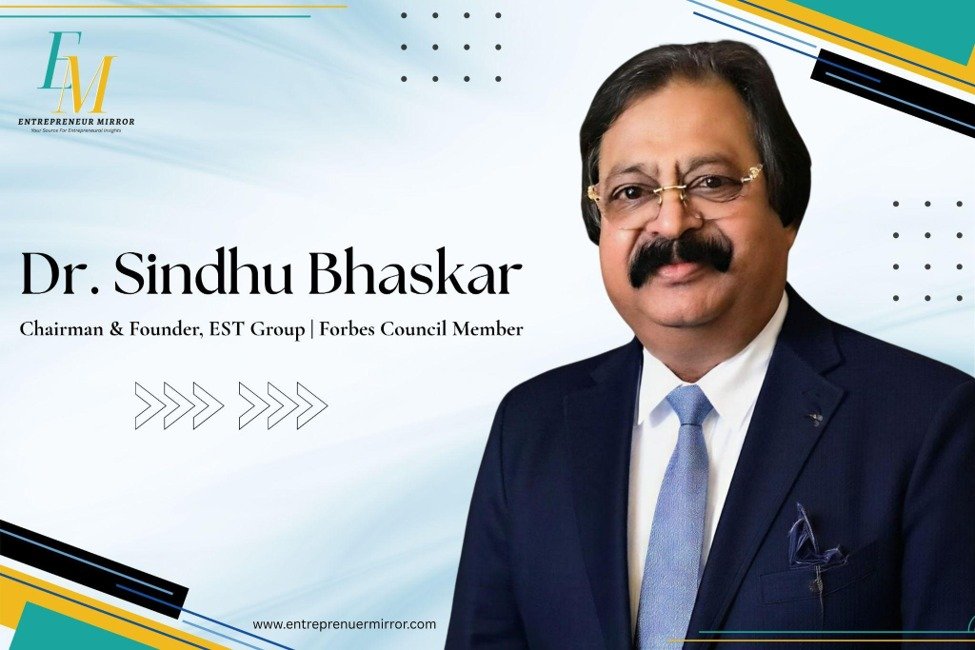
Dr. Sindhu Bhaskar is the Chairman and Founder of EST Group and a global technology strategist working across financial services, digital transformation and inclusive innovation. With around three decades of experience in banking, fintech and emerging technologies, he has focused his work on using digital systems to address economic and social challenges.
Based within the Cambridge Innovation Center in the MIT ecosystem, EST Group brings together initiatives across fintech, agritech, healthcare, education, deeptech and sustainability. Rather than developing these areas in isolation, Dr. Sindhu is building an interconnected ecosystem designed to connect technology with practical needs, particularly in rural communities and underserved markets.
We spoke with him about his journey, the thinking behind EST Group, financial inclusion, emerging technologies and his vision for sustainable development.
A Career Shaped by Financial Transformation
We began by asking, “You have spent around three decades working across banking, financial services and emerging technology. What first drew you towards transforming the financial ecosystem, and how has your thinking changed over the years?”
Dr. Sindhu explained, “My journey has been shaped by a belief that finance should serve as an engine of economic development. Banking has traditionally been built around established systems, processes and institutions. But as I worked across financial services and technology, I began to see how much more could be achieved by connecting these systems with emerging digital capabilities.
The financial sector is not just about transactions. It influences how people build businesses, access opportunities and participate in economic growth. Yet large sections of the population, particularly in rural and underserved communities, continue to face barriers to financial services.
Over the years, my thinking has moved beyond digital banking as a technology upgrade. I see it as an opportunity to redesign how financial services connect with people, businesses and communities. This requires combining banking principles with technologies such as AI, blockchain, digital identity and connected platforms.
For me, the real measure of transformation is not how advanced a system appears. It is whether it makes financial services more accessible, useful and responsive to the needs of the people who depend on them.”
Building an Interconnected Ecosystem Through EST Group
EST Group brings together ventures across several sectors, including fintech, agritech, healthcare, education and deeptech. We asked, “What led you to build EST Group as an interconnected ecosystem rather than a collection of separate technology businesses?”
He shared, “I have always believed that many of the challenges facing communities cannot be solved through one product or one sector. Financial inclusion, agriculture, healthcare and education are closely connected. If we address one area without considering the others, the impact can remain limited.
This thinking led us to build EST Group as an interconnected ecosystem. For example, a farmer’s agricultural and carbon data can support access to financial products. A remote healthcare service can connect with a digital wallet. Students who gain technology skills through our education initiatives can also contribute to projects within the wider ecosystem.”
“Each vertical has its own purpose, but the larger value comes from how they work together. Our initiatives span fintech and digital inclusion, agritech and carbon credits, healthcare, edtech, deeptech and the space economy.
We also believe that building an ecosystem requires collaboration. We work with startups, universities, researchers, governments, financial institutions and entrepreneurs. The aim is to bring different capabilities together and create solutions that can respond to real needs across markets.” Dr Sindhu further added.
Rethinking Banking and Financial Inclusion
Digital banking and financial inclusion remain central to Dr. Sindhu’s work. His vision is to make banking as intuitive as unlocking a phone with a fingerprint. We asked, “What needs to change in the traditional banking model to make financial services more accessible, particularly for people in rural and underserved communities?”
Dr. Sindhu Bhaskar noted, “Banking needs to become easier to access and simpler to use. For many people, particularly in rural communities, the challenge is not only the availability of financial services. It is also the complexity of accessing them and the distance between traditional banking institutions and everyday needs.
I believe banking should become as intuitive as unlocking your phone with a fingerprint. People should not have to navigate complicated processes to access basic financial services. Technology can help make this possible through digital banking, wallets, payment gateways, lending systems and secure digital identities.
However, digital development banking must retain the principles of classical banking. Trust, security, accountability and sound financial practices remain essential. Emerging technology should strengthen these principles rather than replace them.
Our work through initiatives such as BranchX, Ezipay Global and other fintech ventures is connected to this wider vision. We want to help create financial systems that reach more people and support economic participation across different communities.”
Connecting Agriculture With Digital Finance
One of EST Group’s major areas of work is agritech, with initiatives focused on rural ecosystems, carbon assessment and digital financial access. We asked, “Why has agriculture become such an important part of your work, and how can technology improve the economic opportunities available to farmers?”
“Agriculture is central to the livelihoods of a large part of the world’s population. Yet farmers often face challenges at different stages of their work, from accessing resources before cultivation to managing production and reaching markets after harvesting.
We need to look at agriculture as a complete economic ecosystem. Technology can help connect these stages through better information, digital systems and access to financial services.
Through EST AgrX and related initiatives, we are working on decentralised rural ecosystems that link pre-farming, farming and post-farming activities. Our work also includes AI-driven soil and carbon assessment, which can help connect agricultural activity with sustainability and carbon-credit opportunities.
The larger objective is to improve the way rural economies function. Farmers should be able to participate in more structured systems, access relevant services and create greater value from their work. This is also where financial inclusion becomes important. Agriculture and finance should not operate as separate worlds.” Dr Sindhu Bhaskas added.
Bringing Healthcare Closer to Underserved Communities
Healthcare is another part of EST Group’s ecosystem, with initiatives focused on remote diagnostics and access to primary care. We asked, “What role can technology play in improving healthcare access in regions where medical facilities and resources remain limited?”
According to Dr Sindhu Bhaskar, “Access to healthcare remains uneven across many regions. People in remote communities may have to travel long distances to reach medical facilities, and this can delay diagnosis and treatment.
Technology can help reduce some of these barriers. Remote diagnostics, AI and robotics can support healthcare delivery in areas where access to medical professionals and facilities is limited. The aim is to make primary healthcare more accessible and connect people with services that may otherwise be difficult to reach.
Through EST RAHA and EST Healthcare, we are working towards this direction. These initiatives are part of a wider approach in which healthcare connects with other parts of the ecosystem, including digital identity and financial services.
I believe technology should help bring essential services closer to people. Its value should be measured by the difference it makes in access, delivery and the everyday lives of communities.”
AI, Blockchain and the Next Phase of Digital Infrastructure
Dr. Sindhu’s work also extends into agentic AI, blockchain, digital identity, quantum technologies and industrial applications. We asked, “As these technologies develop, where do you see their greatest potential, and what should organisations consider before adopting them?”
He shared, “AI, blockchain and other emerging technologies are creating new possibilities for how organisations operate and how services are delivered. But adopting technology simply because it is new is not enough. We need to understand the problem first and then identify the right technology to address it.
AI can support analysis, automation and decision-making. Blockchain can contribute to secure digital infrastructure and identity systems. Agentic AI introduces another dimension by allowing systems to carry out tasks towards defined goals. Each of these developments has potential, but they also require careful consideration of governance, security and accountability.”
He further added, “Organisations should look at how these technologies fit into their existing systems and what outcomes they are expected to deliver. They must also consider the people affected by these changes.
At EST Group, our approach is to explore technology across practical applications, including digital finance, agriculture, healthcare and manufacturing. We are interested in solutions that can work across different environments and contribute to long-term development.”
Knowledge Sharing and the Next Generation of Innovators
Alongside his commercial ventures, Dr. Sindhu leads EST FAB, a knowledge-empowerment initiative with 35 global chapters. Its programmes include webinars, international internships and mentoring, conducted on a pro bono basis. We asked, “Why is knowledge sharing such an important part of your work, and what do you hope to achieve through EST FAB?”
Dr. Sindhu reflected, “Knowledge should not be restricted by geography or economic background. There are talented students and young entrepreneurs across the world who have the ability to contribute, but they may not always have access to the right networks, practical learning opportunities or industry exposure.
EST FAB was developed to help address this gap. Through our global chapters, we organise webinars, knowledge exchanges, technology forums and internship programmes. These initiatives give students opportunities to learn from professionals and gain exposure to projects across areas such as fintech, blockchain, agritech and healthcare.
The programme is conducted pro bono because I believe access to knowledge should not depend on a person’s financial circumstances. We also encourage young people to become active contributors rather than simply recipients of information.
My aim is to build a network of creators and carriers of change. Young people should have the opportunity to develop ideas, work with experienced professionals and take part in solving real-world challenges.”
Leadership, Collaboration and Global Partnerships
With initiatives and partnerships spanning multiple countries, Dr. Sindhu’s work depends on collaboration across institutions, industries and regions. We asked, “How do you approach building partnerships across different markets, and what have you learned about leading an ecosystem with such a wide range of stakeholders?”
“Building across different markets requires an understanding of local needs. A solution that works in one country may need a different approach in another because the financial systems, regulations, infrastructure and community requirements can vary.
I believe partnerships are essential because no single organisation can build everything independently. We bring together financial institutions, technology companies, universities, researchers, investors and entrepreneurs to complement one another’s capabilities.
Our presence across multiple countries has reinforced the importance of understanding these differences. It is not enough to introduce a technology and expect it to work everywhere. We need local knowledge, trusted partners and the ability to adapt to the environment.
My approach to leadership is therefore collaborative. I value people who bring different experiences and perspectives. The strongest ecosystems are built when participants have a shared purpose and can contribute their expertise towards a wider goal.” Dr Sindhu explained.
Looking Ahead: Technology With a Human Purpose
As EST Group continues to expand across sectors, Dr. Sindhu remains focused on connecting technology with sustainable development and human progress. Lastly, we asked, “What is your long-term vision for EST Group, and what would you like its work to achieve for communities and economies around the world?”
He concluded, “My long-term vision is to build an ecosystem where technology, finance, sustainability and knowledge work together to improve human lives. We are working across several sectors, but the underlying purpose remains consistent: to create systems that support economic participation and make essential services more accessible.
I see significant opportunities in rural development, financial inclusion, sustainable agriculture, healthcare and digital education. These areas need solutions that are connected rather than isolated. When financial services support farmers, when healthcare reaches remote communities and when young people gain access to technology education, the impact can extend across generations.
We will continue to develop our initiatives, strengthen partnerships and explore emerging technologies. But growth alone is not the objective. What matters is whether the work creates lasting value for people and communities.
I often return to the belief that real transformation occurs when technology, sustainability, knowledge and humanity evolve together. That is the direction I want EST Group to continue pursuing.”
Connect with Dr Sindhu Bhaskar on LinkedIn
Follow Est-Grp on LinkedIn or visit http://www.estgrp.net/ for more.
Also Read:-