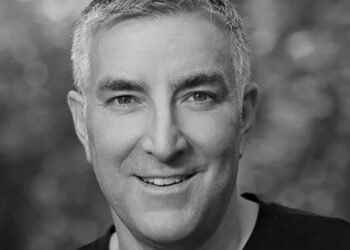
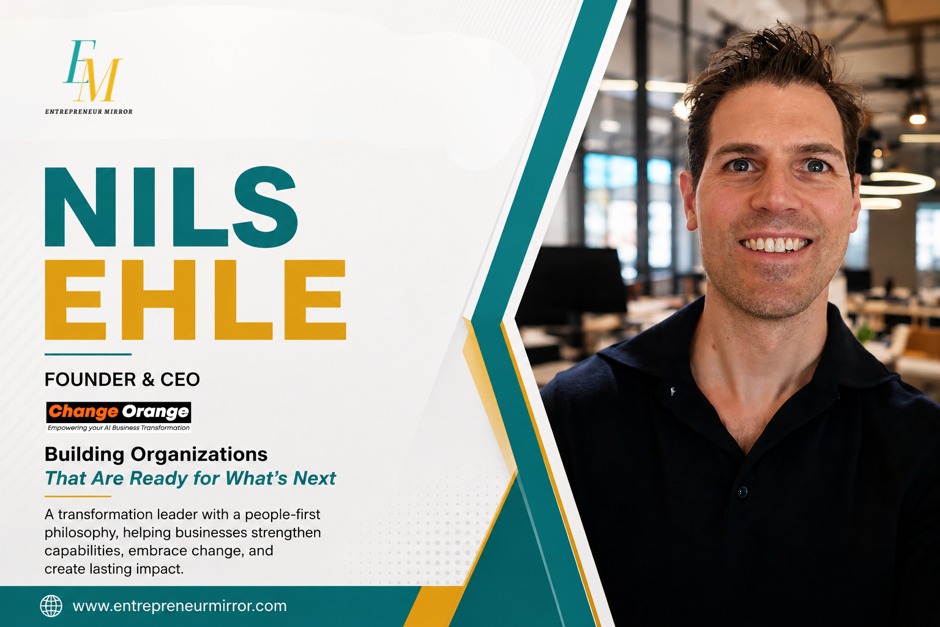
Some founders start a company because they spot a gap in the market. Nils Ehle started his because he got tired of watching good technology get wasted inside organizations that weren’t ready for it. Today, as Founder & CEO of Change Orange, Nils Ehle runs one of the more distinctive AI transformation practices in Europe, one built less on software and more on people, patience, and a refusal to treat AI as a shortcut.
From Corporate Ladder to Founder’s Path
Nils Ehle didn’t set out to be an entrepreneur in the traditional sense. His early career ran through Accenture and then E.ON, the energy giant, where he cut his teeth in IT transformation before moving closer to the operational side of the business. “The core problem back then was that technology was treated as an IT domain,” Nils Ehle recalls. “It rarely delivered what the business actually needed.”
That frustration became fuel. In 2012, Nils Ehle was handed the freedom to build an international transformation unit spanning 12 country markets, reporting straight to the board. From there, he helped stitch together a cross-company innovation hub in Germany’s Ruhr Valley, pulling roughly 80 organizations into one ecosystem, corporates, startups, universities, public bodies, and even direct competitors of his own employer. The goal was simple: match the right solutions to the right problems and help companies adapt their culture along the way.
By 2015, that instinct to build something of his own had grown too strong to ignore. Nils Ehle founded Change Orange as a side project focused on customer-centric redesign. It has since become his full-time calling, now dedicated entirely to helping organizations turn AI hype into measurable business value, without losing the human plot along the way.
What Nils Ehle actually delivers stretches well past a diagnosis. His engagements typically start with AI strategy development, but run through full end-to-end AI business transformation, business model and operating model redesign, workforce capability building, and the change management work needed to make any of it hold. “Assessing where a company stands is only the starting point,” Nils Ehle says. “The real work is walking through the whole journey with a founder, from strategy to the operating model to the people doing the work every day.”
Why Founders Should Stay Uncomfortable
Ask Nils Ehle how he decides which opportunities to pursue, and he won’t talk about market sizing or funding rounds. “You have to refuse to get stuck on the skills and projects you’ve already done,” he says. “AI is the current layer to embrace, and it’s fundamentally a business skill, not a technology topic.”
For Nils Ehle, the engagements worth taking are the ones with a genuine spark in them, a client who wants to build something real rather than simply cut costs. “If you want to stay relevant, you cannot stay in your comfort zone, not as a founder, not as a company,” he says. “Comfort is where reinvention quietly dies.”
Building Core Strength Instead of Chasing Use Cases
Many entrepreneurs building in the AI space fall into the same trap: leading with flashy use cases instead of foundational capability. Nils Ehle sees this constantly in the clients who come to him after a failed pilot. “AI business transformation is not a use-case sport. It’s a capability-building exercise,” he says.
That thinking shaped Change Orange’s six-dimensional AI Business Maturity Model, covering data, technology infrastructure, organization and process design, team skills, strategic alignment, and leadership culture. Only two of those six dimensions are actually about AI. “It’s like someone who only trains their biceps at the gym,” Nils Ehle explains. “Impressive to look at, useless the moment something unexpected happens. You need a strong back, strong legs, a strong core.”
A Founder’s Take on Leadership
Running a growing practice has sharpened Nils Ehle’s views on what leadership actually requires in an AI-saturated world. He points to an image he returns to often: the elephant, whose heart weighs roughly five times more than its brain, compared to humans, where the ratio is reversed. “Most modern leadership is built on that imbalance, heavy on analysis, light on heart,” he says. “The founders and leaders I see succeeding are the ones who deliberately shift toward heart-based leadership.”
He’s equally direct about vulnerability at the top. “You do not have to have all the answers,” Nils Ehle says. “The leaders I see thriving are willing to stand in front of their teams and say, I don’t know yet, let’s figure this out together.”
The Product Behind the Practice
Alongside consulting, Nils Ehle has been building AI Use Case Engine with network partners, a real-time system that breaks a company down into its core business capabilities, then proposes and prioritizes AI and automation use cases benchmarked against real-world examples. “We deliberately run it alongside human experience and intuition that AI alone can’t provide,” he says, describing it as pairing narrow artificial intelligence with what he calls general human intuitive intelligence.
Advice for Founders Building Anything Right Now
Asked what advice shaped his own founder’s path, Nils Ehle doesn’t reach for a productivity hack. “Don’t follow a career path, follow your path. Listen to what your heart is telling you,” he says. “But feeling right has to come from a place of service, not ego. When you act from ego, you optimize for status. When you act from service, you optimize for impact.”
He adds a shorter list underneath that: be yourself, be honest, have fun at work, and don’t try to solve problems alone. “And be fearless,” he says. “Being fearless doesn’t mean never feeling fear. It means refusing to let fear be the deciding factor.”
Staying Grounded While Building
For all the talk of AI and business models, Nils Ehle is unusually candid about what keeps him functional as a founder: going analog. He plays the handpan, runs, does physical work, and spends time in nature with his family. “Those moments aren’t breaks from work, they’re part of how the work happens,” he says. “New ideas rarely arrive when you’re staring at the problem. They arrive when you’ve stepped away.”
He describes his approach to balance less as a goal and more as a practice of letting go. “When you operate from a controlling stance, you live from ego, and you spend enormous energy fighting reality,” Nils Ehle says. “Once you live differently, balance stops being something you achieve. It becomes something you are.”
Nils Ehle speaks regularly on leadership in the age of AI and building organizations for AI readiness. He can be followed on LinkedIn, X, YouTube, and TikTok, and more on his work is available at www.changeorange.com
Also Read:-